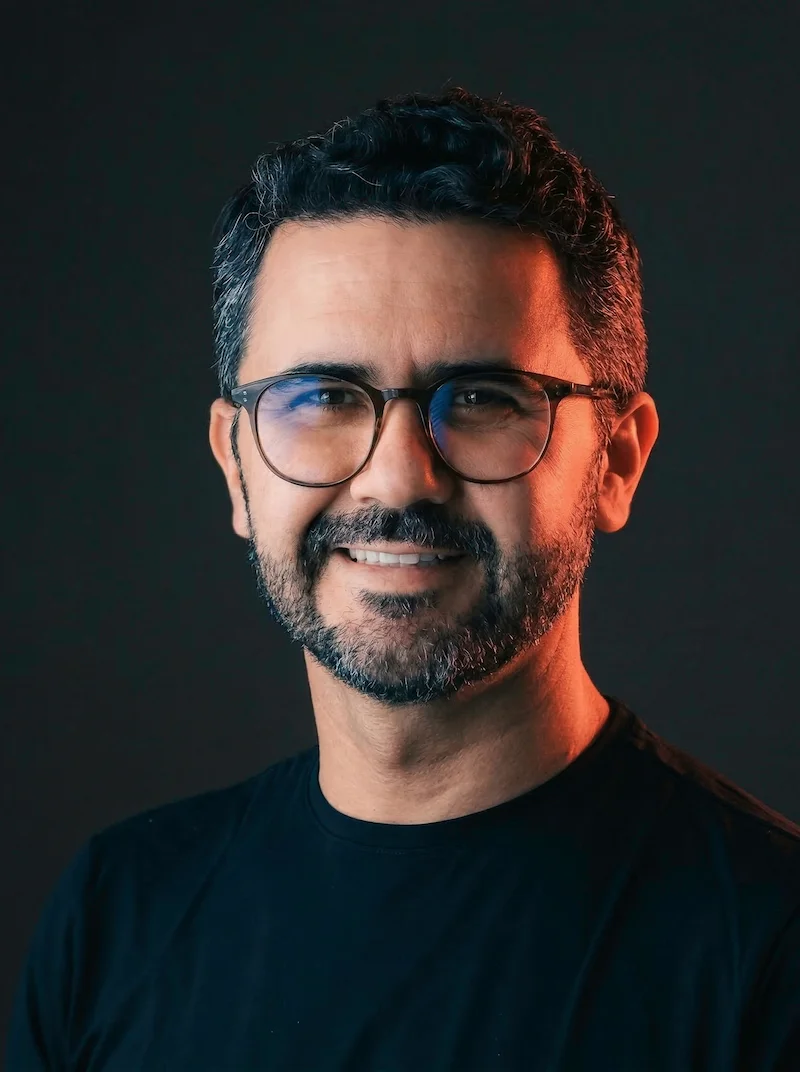
Strategy without structure collapses under its own weight. I build the architecture between the two — systems that endure as the organization scales, the market shifts, and the pressure compounds.
Most professionals choose between being systematic or being creative. I've spent my career at that line — not refusing it, but finding that the line itself was wrong. Good architecture doesn't constrain intuition. It gives it somewhere to go.
I believe that self-knowledge is engineering, not therapy. Understanding how you think — your cognitive signature, your pattern of insight, your specific mode of generating clarity — is the most underused advantage any person or organization has.
Real clarity preserves nuance. The goal is never to make things simpler — it's to make them navigable.
Technology and process should adapt to cognitive style — not the other way around. One-size fits no one.
My role is to lower the activation energy between what an organization knows and what it can do. The transformation belongs to them.
I grew up fascinated by how things work — the why underneath the how. Electronic Engineering gave me the language. The equations didn't just describe circuits; they described everything. That's when the curriculum stopped being enough.
My first job was at a brewery — one of the largest companies in my country, best-in-class technology, and a team I'll miss for the rest of my life. It was there I built my first smart manufacturing system: live operational dashboards from equipment that was already networked, already talking, just not to anyone useful. I didn't wait for permission. I had the tools, the need, and the people asking for it. That was the first time I felt it — what these hands and this mind were actually capable of doing.
Chile first, then the United States. Two deliberate moves into discomfort — each one a decision to find out what I'm capable of in a larger arena. In Chile I learned to listen to clients I'd never met and translate their problems into things that could actually be built. In the US, I learned to do all of that in another language, in a market with no shortcuts and no inherited credibility. Anxious at times. Alone at times. But convinced — the way you can only be convinced after you've felt the friction — that the process is worth it.
What never changed: the people running the systems matter as much as the systems themselves. Technology is only as good as its fit to the humans using it. That's what I build for. That's what I've always built for.
In practice, that looks like this:
A platform that transforms ideas into optimized prompts — calibrated to the user's cognitive style, so every interaction with an LLM has real impact. Built on the belief that the quality of your questions determines the quality of your intelligence.
Designed and deployed a RAG-powered intelligence layer for a Rockwell Automation ecosystem — integrating MES, QMS, and CMMS data into an accessible, context-aware interface for operations teams.
A method for interrogating the self you inherited and constructing the one that actually holds. First principles applied inward.
What holds, what breaks, and what gets rebuilt. These are the dispatches.
Most AI conversations produce more heat than movement. The actual work is signal reduction — knowing what to ignore, what to sequence, what actually applies to this organization, at this moment. That's what separates a trusted advisor from another voice in the room.
Still testing this one against every engagement.
When a system truly fits its users, it disappears into the workflow. Friction is always a design failure. The measure of good systems thinking is not the elegance of the diagram — it's the absence of workarounds.
The workaround count is the metric I actually track.
Organizational performance has a ceiling most teams never examine: they don't know how their people actually think. Not personality types — cognitive signature. How specific people connect, generate insight, move from ambiguity to clarity. Build around that, and the tools finally have somewhere useful to go.
Thinking in public — on AI adoption, manufacturing systems, and the gap between what technology promises and what operations actually need.
Ideas that don't fit in a diagram. Published on In Essence .
Presence, Intention, and Trace — on the idea that everything passing through us leaves transformed, not because we control it, but because we are here.
Read →What I'm thinking about, before I've fully figured it out. Published twice a month.
Subscribe freeThis page is a living document. So is the conversation I'm trying to start.
I'm interested in conversations about senior IC roles in AI strategy, solutions architecture, or human-centered product development — and in advisory relationships with teams navigating AI adoption in industrial or enterprise contexts.